

What Does a Long-Term Care Ombudsman Do in California?
Quick answer: The Long-Term Care Ombudsman is a free, confidential advocate for people who live in nursing homes and assisted living facilities. Ombudsman representatives can walk into a facility, talk privately with a resident, investigate a complaint, and press the staff to fix the problem. They work for the resident, not the facility and not the family, and they follow the resident's wishes. The ombudsman cannot fine a facility, award money, or represent anyone in court. In California you can reach the statewide line at 1-800-231-4024 or send us a message at any hour, and every facility must post the number for its local office.
Most families hear the word "ombudsman" for the first time on a poster by the nursing home's front desk. It is worth knowing what that office can do before you need it, because it is often the fastest way to get someone with real access into the building.

Who the Ombudsman Is
The program runs under the federal Older Americans Act and California's own Long-Term Care Ombudsman Act. The Office of the State Long-Term Care Ombudsman sits in the California Department of Aging, and it designates local programs (usually nonprofits or county agencies) to do the day-to-day work in each area.
Under Welfare and Institutions Code section 9701, the program covers two kinds of facilities: skilled nursing facilities and residential care facilities for the elderly, which most people call assisted living or board and care. If you are not sure which kind of facility your parent lives in, our guide to assisted living vs. nursing homes in California explains the difference. The ombudsman serves residents in both.
Many local representatives are trained, state-certified volunteers. They visit facilities regularly, so residents and staff often know them by name. The California Department of Aging's ombudsman page lets you find the local office by county.
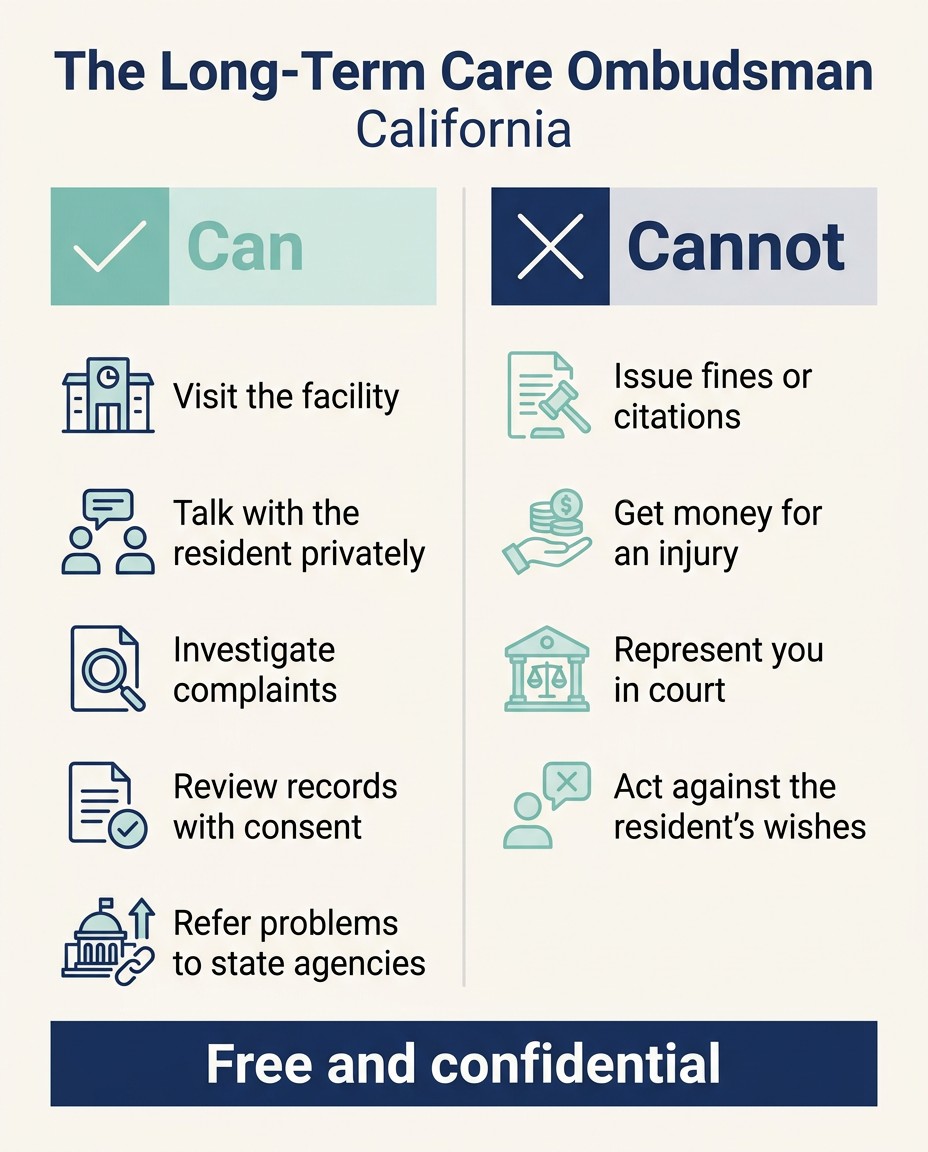
What the Ombudsman Does
The core job is hearing and resolving complaints. The federal rule, 45 CFR 1324.19, says it plainly: no matter who makes the complaint, the ombudsman serves the resident, and the goal is to resolve the complaint to the resident's satisfaction. That includes complaints about abuse, neglect, and exploitation.
California law gives representatives the access to do that. Under section 9722, they have the right to enter long-term care facilities and move through them unescorted, to speak with residents confidentially, and to get a list of current residents and their rooms on request. Under section 9724, they can review a resident's medical and personal records with the resident's consent (written if the resident can write, oral before a witness if not), or with a conservator's permission in some cases.
The ombudsman can also send a problem to the agencies that have enforcement power. Section 9721 lets the office refer complaints to state licensing agencies and boards, and it requires those agencies to give the referrals priority. For nursing homes, that usually means the California Department of Public Health. Our page on how California regulates nursing homes explains who does what.
The California Department of Aging lists the kinds of problems the ombudsman handles, including violations of residents' rights, abuse, poor care, food and diet complaints, Medicare and Medi-Cal benefit issues, improper transfers or discharges, and the misuse of physical or chemical restraints. Many of these are rights violations we cover in our guide to California nursing home residents' rights.
The Ombudsman Follows the Resident's Wishes
This part surprises families. If your mother can make her own decisions, the ombudsman takes direction from her, not from you. The federal rule requires the representative to talk with the resident about the complaint, learn what she wants, explain her rights, and work out a plan with her. If she asks them to drop it, they generally will.
Confidentiality is just as strict. Under section 9725, the office's complaint files and the identities of complainants, witnesses, and residents stay confidential unless the resident or her legal representative agrees, a court orders disclosure, or the information goes to law enforcement, protective services, or a licensing agency in a way federal law allows. A resident who is afraid of retaliation can raise a problem without the facility learning who complained. Section 9715 also bars a facility from retaliating against residents or staff who give information to the ombudsman in good faith.
That confidentiality protects residents, and it has a cost for families. The same section says ombudsman representatives cannot be required to testify in court about confidential matters, except where a court finds it necessary to enforce the program's own law. Do not count on the ombudsman's file to prove your case later. Keep your own notes, dates, photos, and names.

When to Call the Ombudsman
Call when something is wrong but nobody is in immediate danger, and you want someone with access to look at it quickly. Good reasons to call:
- Care problems that keep repeating: call lights ignored, missed meals, a parent left wet or unwashed.
- Early signs of neglect, such as weight loss, new bruises, or a wound that is not healing. Our checklist of the signs of nursing home neglect can help you spot them.
- A transfer or discharge notice. Federal rules require a nursing home to send a copy of a discharge notice to the ombudsman, and the notice itself must list the ombudsman's contact information under 42 CFR 483.15. Call as soon as the notice arrives.
- Problems with visitors, belongings, money, or a care plan the facility will not discuss.
- An advance health care directive. Under Probate Code section 4675, a directive signed by a skilled nursing facility patient is not effective unless a patient advocate or ombudsman signs as a witness. Families often learn this only after the paperwork is rejected.
If your loved one is in danger right now, call 911 first. For abuse, the ombudsman is one of several places to report, alongside the Department of Public Health and, in some situations, Adult Protective Services. Our step-by-step guide on how to report nursing home abuse in California and the report abuse pages for each county list the numbers. To start a state investigation, see how to file a complaint against a California nursing home.
What the Ombudsman Cannot Do
The ombudsman is an advocate, not a regulator and not a lawyer. It does not license facilities, issue citations, or levy fines. It cannot get your family compensation for an injury, a hospital bill, or a death. And because it follows the resident's wishes, it may not take the step a worried family wants it to take.
When neglect has already caused harm, such as a fall with a fracture, a pressure injury, an infection, or a death, a legal claim may exist under California's Elder Abuse Act and related laws. Our overview of California nursing home neglect laws explains how those claims work, and the statute of limitations guide explains the deadlines. A call to the ombudsman does not pause those deadlines.
Talk With Us If Your Loved One Was Hurt
The ombudsman and a lawyer do different jobs, and many families need both. If a nursing home or assisted living facility's neglect injured someone you love, or an assisted living facility failed to give the care it promised, call (888) 999-0169 or send us a message. When you contact us, we talk with you about what happened. The consultation is free, and you pay nothing unless we win.
Frequently asked questions
Is the long-term care ombudsman free in California?
Yes. Ombudsman services are free, and complaints are confidential. The program serves residents of nursing homes and assisted living facilities regardless of age.
Can a family member call the ombudsman, or only the resident?
Anyone can call, including family, friends, and facility staff. The ombudsman will still talk with the resident and, if the resident can make decisions, follow the resident's wishes about how to handle the complaint.
Does the ombudsman report abuse to the state?
The ombudsman can refer complaints to licensing agencies, law enforcement, and protective services, but federal rules generally require the resident's consent before the ombudsman shares the resident's identity. If you want a state investigation, you can also file your own complaint with the California Department of Public Health.
Can the ombudsman stop a nursing home discharge?
The ombudsman cannot overrule a facility, but it receives a copy of nursing home discharge notices and can help a resident understand the notice, raise concerns with the facility, and work through the appeal process the notice describes. Call as soon as you get the notice.

Free Case Evaluation
Confidential. No obligation. Available 24/7.