

Quick answer: The most common signs of nursing home neglect are unexplained pressure sores, sudden weight loss or dehydration, repeated falls, poor hygiene, and a resident who becomes withdrawn or fearful. Neglect usually traces back to too few staff, not bad luck. If you notice these signs, document them, request the medical records, and report your concern to the California Department of Public Health and the local long-term care ombudsman.
You will usually sense that something is wrong before anyone official does. Trust that instinct. You know what your mother looked like last month; the state inspector does not. Here are the warning signs families most often see, grouped by where they show up, followed by what to document and when to bring in a doctor.

Physical signs
Physical signs are the most reliable, because they can be photographed and matched against the medical chart later.
- Pressure sores, also called bedsores: a wound over a bony area such as the tailbone, heels, or hips. Advanced pressure ulcers are considered preventable in most residents and are one of the clearest signals of neglect. A stage 3 or stage 4 sore means the failure went on for a long time.
- Sudden weight loss, sunken eyes, or dry, cracked lips. These point to dehydration or malnutrition: food set down out of reach, no help eating, no one tracking fluids.
- Repeated falls, bruises, or fractures, especially in a resident who was assessed as a fall risk and was supposed to be supervised. See falls and fractures.
- Poor hygiene: unwashed hair, long or dirty fingernails, dirty clothing or bedding, a strong smell of urine, or a brief that clearly has not been changed.
- Untreated infections, or a resident who is suddenly confused, feverish, or lethargic. Urinary tract infections and infected wounds can progress toward sepsis fast in an elderly person, and confusion is often the first symptom.
- Medication problems: missed doses, a resident who seems drugged, or a new prescription no one told the family about. Serious medication errors put residents in the hospital.
None of these signs proves neglect by itself. What matters is whether the facility assessed the risk, planned for it, and followed the plan. The medical records show exactly that, which is why requesting them early matters.
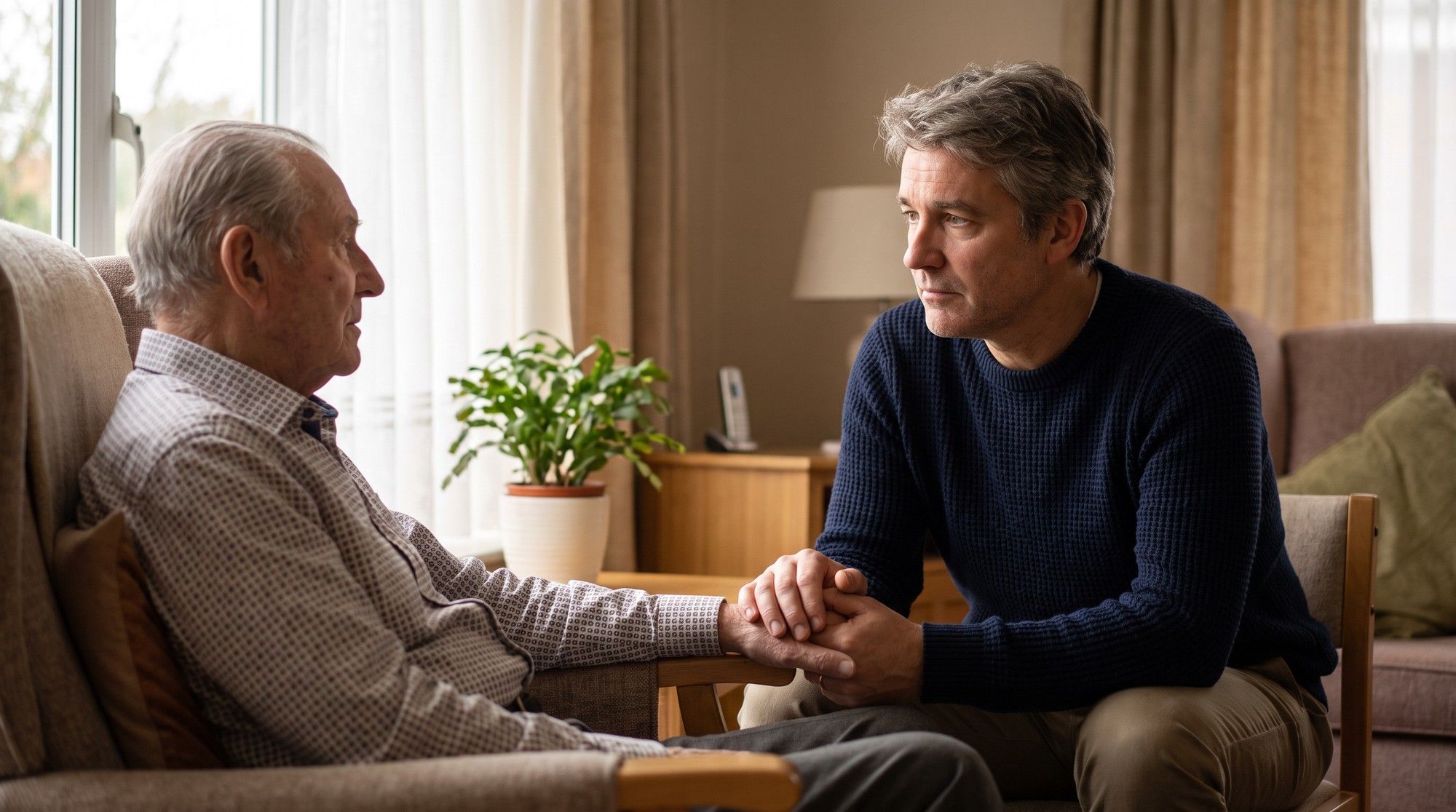
Behavioral and emotional signs
Behavioral changes are easier to dismiss and just as important. A resident who cannot describe what is happening will still show you.
- A resident who becomes withdrawn, anxious, or fearful, particularly around certain staff members.
- New agitation, depression, or a reluctance to speak in front of staff. Watch whether answers change when an aide leaves the room.
- Being over-medicated or unusually sedated. A parent who was alert last month and is now sleeping through your visits may be chemically restrained. Sedation is sometimes a substitute for supervision on a short-staffed unit.
- Rocking, flinching at touch, or other self-soothing behavior that was not there before. In residents with dementia these can be the only visible signs of emotional abuse or long stretches of being left alone.
If your loved one says something is wrong, take it at face value first. Families are often told a complaint is just the dementia talking. Sometimes it is. Often it is not, and residents who are ignored tend to stop reporting.
Facility and environmental signs
The building itself tells you how a facility is run.
- Call lights that go unanswered for long stretches. Stand in the hallway and count the minutes; it is the simplest test a family can run.
- Too few staff visible, especially evenings, overnight, and weekends. If you cannot find an aide during a visit, imagine the resident who needs one at 2 a.m.
- Residents parked in wheelchairs in hallways for hours, or left in bed all day with no activity.
- A strong odor of urine throughout a unit. One room can be a moment in time. A whole hallway is a staffing problem.
- Doors propped open, broken wander alarms, or confused residents near exits: the conditions behind elopement and wandering injuries.
- Staff who are evasive about a resident's condition, discourage visits at certain times, or never seem to be the same people twice. Constant turnover means no one on the floor really knows your parent.
Compare what you see against the facility's public record. Look up its state citations and complaint history in our California nursing home directory, and check its federal rating through CMS star ratings, keeping in mind that parts of that rating are self-reported.
What to look for on a visit
Most families visit for an hour at a time, so it helps to know where to look.
Start with your loved one. Look at their weight, skin, fingernails, and hair. Are they dressed, or in the same gown as last time? Are their glasses, hearing aids, and dentures in place? Ask when they last had a shower.
Then look at the room. Is the water pitcher full and within reach? Is the call button where a hand can find it? Check the sheets, the floor, and the bathroom.
Then look past the room. Notice how long call lights stay on down the hall, how many staff you pass, and how they speak to residents. Vary your visiting times when you can. Facilities look their best at 11 a.m. on a Tuesday; evenings, weekends, and holidays show you the real staffing level. If you cannot visit in person, video calls still help: watch for weight change in your loved one's face and ask the aide to pan the camera.
If what you are seeing has already gone past warning signs and into real harm, you do not have to sort out the legal side alone. Young & Wallin reviews nursing home neglect cases at no charge, and you pay no fee unless we win. Call (888) 999-0169 or send us the details online.
One bad day or a pattern?
Every nursing home has hard days. A missed shower during a flu outbreak or one slow response to a call light is frustrating, but not neglect on its own. The legal question in California is whether the facility failed to provide care it knew the resident needed, and patterns prove that better than single incidents.
A useful way to think about it: an event with an explanation, an apology, and a fix is probably a bad day. The same event repeating, or different failures pointing at the same cause, is a pattern. Three missed showers in two weeks, a weight log showing steady loss, a second fall after the first was supposed to trigger new precautions: each of those is a pattern.
The other tell is how the facility responds when you raise it. A well-run home answers questions, shows you the care plan, and changes something. A poorly run home gets defensive, blames the resident, or says nothing happened. When staff explanations keep shifting, write each version down with the date. Shifting stories matter later.
What to document and photograph
Good documentation makes every later step easier: the complaint, the medical review, and any legal case. Start the day you first feel uneasy.
- Photograph injuries: pressure sores at every dressing change you witness, bruises from more than one angle, with something for scale. Most phones date photos automatically.
- Photograph conditions: the unchanged brief, the empty water pitcher, the call light out of reach, the untouched meal tray.
- Keep a dated written log of visits: what you saw, what your loved one said, which staff you spoke to, what they told you. Names and quotes beat summaries.
- Save care conference notes, emails with the facility, text messages from staff, and billing statements.
- Request the complete medical chart in writing, including care plans, nursing notes, weight and fluid logs, repositioning records, and incident reports. A written request creates a paper trail if the facility stalls.
Do not announce a lawsuit or confront staff with your evidence. Collect it quietly. Records get harder to obtain once a facility feels threatened, and the chart as it exists today is the chart you want.
When to call a doctor, and when to call 911
Some signs are a legal question later and a medical question right now. This guide is not medical advice; when in doubt, ask a doctor.
Call the resident's physician promptly, or ask for an urgent medical evaluation, if you see a new or worsening pressure sore, sudden confusion, fever, unexplained weight loss, signs of dehydration, a fall the facility brushed off, or heavy new sedation. You can also request, in writing, that your loved one be sent to a hospital. Families sometimes learn how severe a wound is only after an emergency room sees it.
Call 911 if your loved one has trouble breathing, chest pain, uncontrolled bleeding, a suspected stroke, a head injury, or cannot be woken. Do the same if you believe they are in immediate danger from anyone in the building. You do not need the facility's permission to call 911, and you should not wait for staff to call first if you are the one seeing the emergency.
After the crisis passes, report it. Our reporting guide covers the California Department of Public Health, the long-term care ombudsman, and Adult Protective Services. For the formal state investigation route, see how to file a complaint against a California nursing home.
Why these signs almost always trace back to staffing
Pressure sores, dehydration, falls, and hygiene failures have one common cause: not enough hands. Repositioning a resident every two hours, helping with meals, and answering call lights all take staff time. When a facility runs short, that basic care gets skipped, and the signs on this page are what skipped care looks like.
We know this from the inside. Before representing families, Thomas Wallin and Michael Young defended nursing homes, and they saw how staffing budgets get set and how understaffing gets explained away after an injury. That experience is why the first documents we pull in a neglect case are the staffing schedules.
What to do if you see these signs
You do not need proof to act, and you do not need to be certain. Write down what you see with dates and photographs. Request the complete medical chart in writing. Then report your concern to the California Department of Public Health and the local long-term care ombudsman; our full walkthrough is here: how to report nursing home abuse in California.
Check the facility's history while you wait, in our California nursing home directory and the California nursing home report card. A home with prior citations for the same problem you are seeing is a home with a pattern.
If the harm is serious, talk to a lawyer before the paper trail goes cold. California's deadlines are shorter than most families expect; the statute of limitations guide explains the timing rules, which can be as short as six months for government-run facilities.
If a loved one was harmed
When the signs on this page turn out to be real harm, the next call matters. Young & Wallin has recovered millions for elder abuse victims, and we started on the other side, defending the same facilities we now hold accountable, so we know how these cases get defended. The consultation is free and confidential, there is no fee unless we win, and we serve families throughout California. Call (888) 999-0169, reach us through our contact page, or learn more on our nursing home neglect page.
Sources and authoritative references
- California Department of Public Health, Cal Health Find: https://calhealthfind.cdph.ca.gov/
- California Elder Abuse and Dependent Adult Civil Protection Act, Welfare and Institutions Code section 15600: https://leginfo.legislature.ca.gov/faces/codes_displaySection.xhtml?lawCode=WIC§ionNum=15600.
- CMS Care Compare: https://www.medicare.gov/care-compare/
Where to Report, and Who Does What
Long-Term Care Ombudsman CRISISline
Investigates abuse and neglect complaints inside long-term care facilities and advocates for the resident. Free, confidential, answered 24 hours a day.
California Department of Public Health, Licensing and Certification
Licenses skilled nursing facilities, investigates complaints and issues the citations that become public record.
Cal Health Find
The CDPH search where a complaint against a named facility is filed, and where the state inspection record for that facility is published.
Adult Protective Services
The California Department of Social Services line for abuse of an elder living in the community rather than in a licensed facility. Answered 24 hours a day, routed to the county agency by zip code.
Medicare Care Compare
The federal ratings, staffing figures and inspection findings this site publishes for every certified home, at their source.
Frequently asked questions
What is the most common sign of nursing home neglect?
Unexplained pressure sores and sudden weight loss or dehydration are the most common signs of nursing home neglect, because they come from basic care being missed. Repeated falls and poor hygiene are close behind, and all of these trace back to too few staff providing daily care.
What are the early warning signs of nursing home neglect?
The earliest warning signs are usually small: an unshowered parent, a water pitcher out of reach, weight coming off the face, unanswered call lights, and a resident who seems flatter or more sedated than before. Early signs matter because pressure sores, dehydration, and falls are far easier to prevent than to treat.
Is neglect the same as abuse?
They overlap under California law. Neglect is the failure to provide care a resident needs; abuse includes intentional physical, sexual, or emotional harm. Both are covered by California's Elder Abuse and Dependent Adult Civil Protection Act, and both can support the same enhanced remedies when the facility's conduct was reckless.
Are bedsores always a sign of neglect?
Not always, but usually. Most pressure sores are preventable with regular repositioning, nutrition, and skin checks, so a serious bedsore in a California nursing home deserves an explanation. A stage 3 or stage 4 pressure sore that developed in the facility is strong evidence that required care was not given.
What should I do first if I suspect neglect?
Document what you see, request the medical records in writing, and report your concern to the California Department of Public Health and the long-term care ombudsman. If your loved one is in immediate danger, call 911; for urgent concerns short of an emergency, call Adult Protective Services. Reporting can be done anonymously.
How do I report nursing home neglect in California?
Report nursing home neglect to the California Department of Public Health, which licenses and inspects nursing homes, and to the local long-term care ombudsman. You can file a CDPH complaint online or by phone, and you can report anonymously. Our reporting guide lists every agency.
How long do I have to sue for nursing home neglect in California?
Most California nursing home neglect claims run on a two-year statute of limitations, while claims based on medical negligence follow MICRA timing: three years from the injury or one year from discovery, whichever comes first. Government-run facilities can require a claim within six months. The statute of limitations guide explains which deadline fits which case.
What is the average settlement for nursing home neglect?
There is no fixed average, and any site quoting one number is guessing. Value depends on the severity of the injury, the strength of the records, the facility's citation history, and whether the evidence supports enhanced remedies under the Elder Abuse Act. Our settlement value guide walks through the factors that move value.
Who is liable for nursing home neglect: the facility or the staff?
Usually the facility, and often the corporate owner above it. Neglect cases typically center on facility-level decisions about staffing and budgets rather than one employee's mistake. Identifying the right corporate defendants is one of the main jobs of a nursing home neglect lawyer.

Free Case Evaluation
Confidential. No obligation. Available 24/7.
Disclaimer: this guide is general information, not legal or medical advice, and does not create an attorney-client relationship. This page is attorney advertising. If a topic here is a sensitive one for your family, know that support is available and you can reach us any time.