

What Is the Difference Between Assisted Living and a Nursing Home in California?
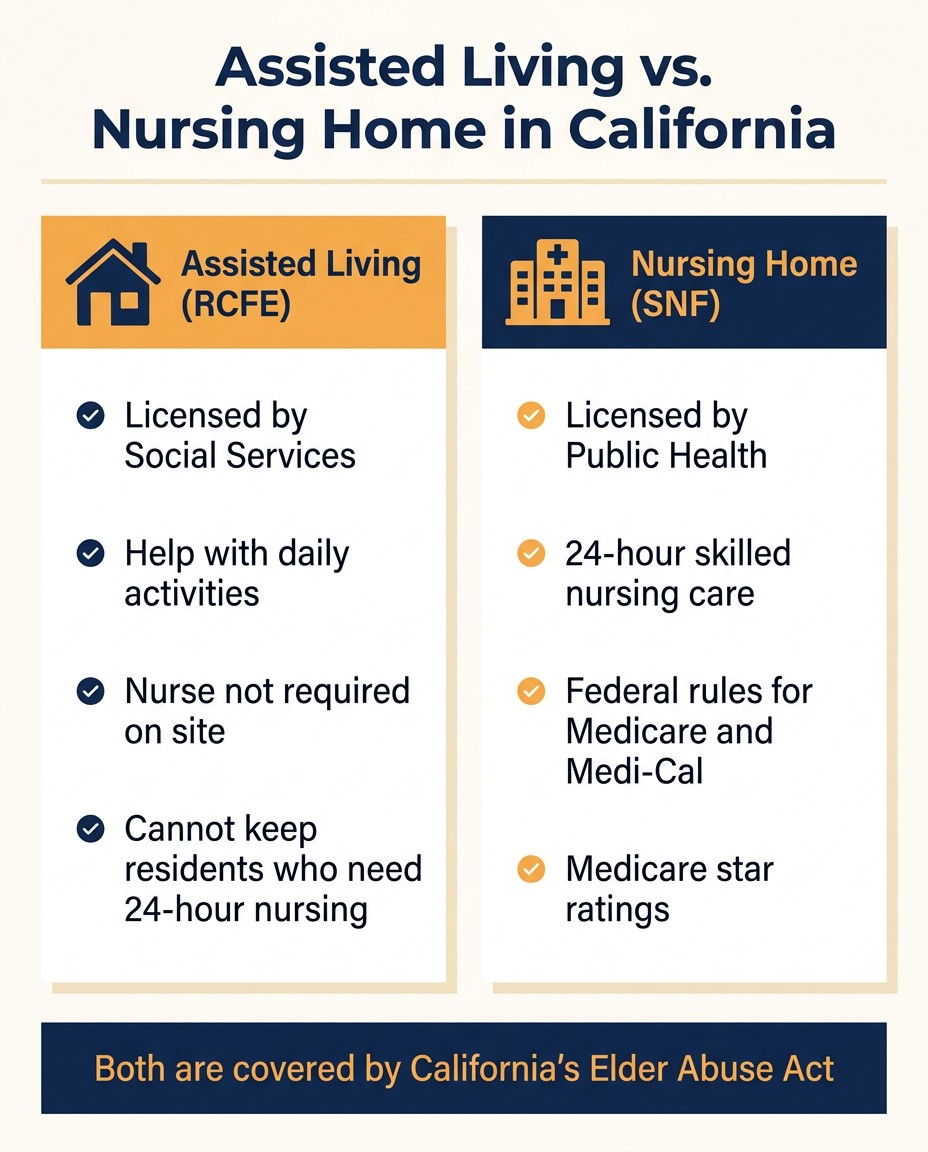
Quick answer: Assisted living in California is a residential care facility for the elderly (RCFE), licensed by the Department of Social Services. It provides housing, meals, and help with daily activities, and it is not required to have a nurse on site. A nursing home is a skilled nursing facility (SNF), licensed by the Department of Public Health, that provides round-the-clock skilled nursing care. The law draws a hard line between them: an assisted living facility generally may not admit or keep a resident who needs 24-hour skilled nursing care. The two settings also have different inspectors, different residents' rights rules, and different ways to check a facility's record.
Most families come to this question in a hurry. A parent falls, spends a few days in the hospital, and a discharge planner asks where they will go next. The brochures all look alike. The legal differences between these two kinds of facilities are much bigger than the brochures suggest, and they affect your parent's safety, what the facility owes them, and what you can do if something goes wrong.
Two Different Licenses, Two Different Agencies
California does not use the term "assisted living" in its licensing law. What most people call assisted living, including many memory care communities and small six-bed board and care homes, is legally a residential care facility for the elderly. Health and Safety Code section 1569.2 defines an RCFE as a housing arrangement chosen voluntarily by people 60 or older (or their representative) where varying levels of care and supervision are provided based on each resident's needs. These facilities are licensed and inspected by the California Department of Social Services through its Community Care Licensing Division.
A nursing home is a different kind of license entirely. Health and Safety Code section 1250 defines a skilled nursing facility as a health facility that provides skilled nursing care and supportive care to patients whose primary need is for skilled nursing care on an extended basis. The California Department of Public Health licenses and inspects these facilities. If a nursing home takes Medicare or Medi-Cal, as almost all do, it must also follow the federal nursing home rules in 42 CFR Part 483.
So an RCFE is, at bottom, a home with care added. A nursing home is a health facility.
What Assisted Living Provides, and Where It Stops
An RCFE provides "care and supervision," which the statute describes as ongoing help with activities of daily living such as taking medications, managing money, and personal care. For a parent who can still get around but needs reminders, meals, and help bathing or dressing, that can be a good fit.
The limits are where families get hurt. Under Health and Safety Code section 1569.72, a resident generally may not be admitted to or kept in an RCFE if they need 24-hour skilled nursing or intermediate care, or if they are bedridden other than for a temporary illness or recovery from surgery (with a narrow exception for facilities holding the right fire clearance). Title 22 adds a list of prohibited health conditions in section 87615, including stage 3 and 4 pressure injuries, feeding tubes, tracheostomies, serious infections, and residents who depend on others for all activities of daily living.
There is one important exception. Under section 1569.73, a facility can get a hospice waiver so that a terminally ill resident can stay, but only if a licensed hospice provides the medical care and the facility can still meet the resident's needs.
In the cases we see, the trouble usually starts when a resident's needs grow past what the facility can handle and nobody says so. A parent who needs two people to transfer, or who has a wound that keeps getting worse, stays put because the room is paid for. That gap is where falls, bedsores, and wandering incidents come from. Our assisted living abuse page covers those cases in detail.
What a Nursing Home Provides
A skilled nursing facility is built for residents who need licensed nurses around the clock: wound care, IV medications, feeding tubes, rehabilitation after a hospital stay, or long-term care for someone who can no longer move or eat without help. California sets minimum nursing staffing levels for these facilities, and federal rules add their own requirements. We explain the numbers in our post on California nursing home staffing requirements.
Nursing homes also carry a heavier set of residents' rights. California's Patient's Bill of Rights and the federal rules give residents specific protections on care planning, restraints, visitors, and discharge, and they let residents and families sue for rights violations. Our guide to California nursing home residents' rights walks through them.
Residents' Rights Are Not the Same
Assisted living residents have rights too, but they come from a different chapter of the law. Health and Safety Code section 1569.269 lists the rights of RCFE residents, including dignity, privacy, freedom from retaliation, food that meets their nutritional needs, and care delivered by staff who are "sufficient in numbers, qualifications, and competency" to meet their needs.
Eviction works differently as well. Under Title 22, section 87224, an RCFE may evict a resident only for listed reasons, such as nonpayment, breaking written facility rules, or a new need the facility cannot meet after a formal reappraisal, and generally with 30 days' written notice. A three-day notice is allowed only with the licensing agency's prior written approval and only for behavior that threatens someone's health or safety. A nursing home discharge follows the federal and state nursing home rules instead.
One protection covers both settings. California's Elder Abuse and Dependent Adult Civil Protection Act applies to nursing homes and assisted living facilities alike, so neglect in either one can support an elder abuse claim. Our post on California nursing home neglect laws explains how that Act works.

Paying for Each: Medicare and Medi-Cal Basics
This is general information, and coverage rules depend on your parent's situation, so confirm details with the plan or a benefits counselor.
Medicare does not pay for room and board or personal care in assisted living. It can cover a limited stay in a skilled nursing facility after a qualifying hospital stay when the resident needs daily skilled care; Medicare explains the conditions on its skilled nursing facility coverage page. Medi-Cal pays for long-term nursing home care for residents who qualify. For assisted living, Medi-Cal's Assisted Living Waiver can help, but it is offered only in some counties and enrollment is limited, so most families pay for assisted living privately.
How to Check a Facility's Record
Because two different agencies license these facilities, you look them up in two different places.
- For assisted living (RCFE), search the Department of Social Services Community Care Licensing facility search for the license, inspection visits, complaints, and citations.
- For nursing homes (SNF), use the CDPH Cal Health Find tool and Medicare's Care Compare, or start with our California nursing home directory, which pulls inspection history, ratings, and citations into one page. Our explainers on CMS star ratings and Class AA citations help you read what you find.
Assisted living facilities do not get Medicare star ratings, so the licensing record is the main thing you have to go on. Read the complaint history, not just the most recent visit.
Questions to Ask Before You Choose
When we worked on the defense side of these cases, the families who protected their parents best asked hard questions up front and wrote down the answers. A few worth asking:
- What happens if my parent's needs increase? At what point would you say this facility can no longer care for them?
- Who is on staff overnight, and is a licensed nurse ever in the building?
- How do you handle falls, wounds, and changes in condition, and how fast will you call me?
- Can I see the admission agreement and the facility's written policies before we sign?
- For memory care, how do you prevent residents from leaving the building unnoticed?
Your local Long-Term Care Ombudsman advocates for residents of both nursing homes and assisted living, and it is a good call to make before you sign anything. If you are already seeing warning signs, our checklist of the signs of nursing home neglect and our guide on how to report abuse in California apply in both settings.
When Care Falls Short in Either Setting
Whether your loved one lives in assisted living or a nursing home, they are owed care that fits their needs. If a facility kept a resident it could not safely care for, or neglect led to an injury, call (888) 999-0169 or send us a message. When you contact us, we talk with you about what happened. The consultation is free, and you pay nothing unless we win.
Frequently asked questions
Is assisted living the same as a nursing home in California?
No. Assisted living facilities are licensed as residential care facilities for the elderly by the Department of Social Services and provide care and supervision, not round-the-clock nursing. Nursing homes are skilled nursing facilities licensed by the Department of Public Health that provide 24-hour skilled nursing care, and most also follow federal Medicare and Medicaid rules.
When does someone need a nursing home instead of assisted living?
California law generally bars an assisted living facility from admitting or keeping a resident who needs 24-hour skilled nursing care or who is bedridden other than temporarily. Title 22 also lists conditions an assisted living facility cannot handle, including stage 3 and 4 pressure injuries, feeding tubes, and tracheostomies. A resident with those needs generally belongs in a skilled nursing facility, with a limited exception for hospice patients under a state waiver.
Can an assisted living facility in California evict a resident?
Yes, but only for reasons listed in Title 22, section 87224, such as nonpayment, breaking written facility policies, or a new need the facility cannot meet after a reappraisal. The facility generally must give 30 days' written notice. A three-day notice requires prior written approval from the licensing agency and is limited to behavior that threatens health or safety.
Can I sue an assisted living facility for neglect in California?
Yes. California's Elder Abuse Act applies to assisted living facilities as well as nursing homes, and negligence and wrongful death claims may also apply when neglect causes injury or death. Strict deadlines apply, so it is wise to speak with a lawyer early.

Free Case Evaluation
Confidential. No obligation. Available 24/7.