

What Laws Protect Nursing Home Residents From Neglect in California?
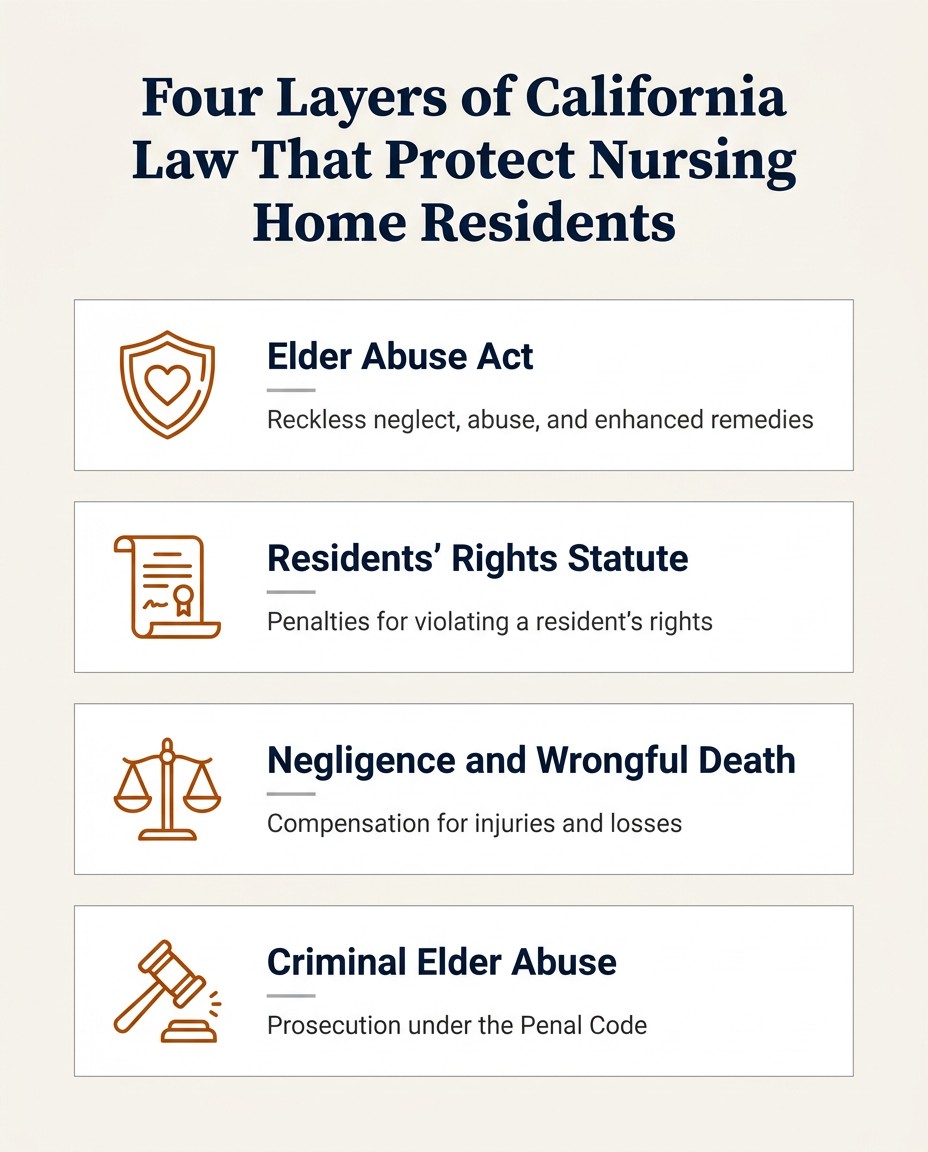
Quick answer: Four layers of California law work together. The Elder Abuse and Dependent Adult Civil Protection Act defines neglect and adds attorney's fees and stronger damages when a facility acts recklessly. Health and Safety Code section 1430(b) lets residents sue for violations of their rights. Ordinary negligence and wrongful death law compensates injuries and losses. And Penal Code section 368 makes elder abuse a crime. State and federal nursing home regulations set the standard each of these laws measures the facility against.
Families usually come to us with one question: "Is what happened to my mother against the law?" The honest answer is that California has several laws that can apply to the same injury, and which ones apply changes what a case is worth, who pays the lawyers, and whether a claim survives if the resident has passed away.
Our explainer on how California regulates nursing homes covers the inspectors and the citation system. This post covers the laws a family can actually use.
1. The Elder Abuse Act: California's Most Important Tool
The Elder Abuse and Dependent Adult Civil Protection Act starts at Welfare and Institutions Code section 15600. It protects people 65 and older, and dependent adults between 18 and 64 whose physical or mental limitations restrict their ability to protect themselves. Nearly every nursing home resident falls into one of those groups.
How the Act Defines Neglect
Under section 15610.57, neglect is the failure of anyone with care or custody of an elder to exercise the degree of care a reasonable person in that position would exercise. The statute spells out examples, including failing to help with personal hygiene or to provide food and clothing, failing to provide medical care, failing to protect the resident from health and safety hazards, and failing to prevent malnutrition or dehydration.
That list reads like a summary of the cases we see: bedsores from residents left in one position, dehydration and malnutrition from residents who could not feed themselves, and falls by residents everyone knew were at risk.
The California Supreme Court has made clear that neglect under the Act requires a caretaking or custodial relationship. A skilled nursing facility that has taken on a resident's daily care has exactly that relationship.
Why "Reckless" Is the Word That Matters
Most of the Act's force comes from section 15657. When a family proves by clear and convincing evidence that a facility was guilty of recklessness, oppression, fraud, or malice in committing neglect or abuse, the court must award reasonable attorney's fees and costs. The section also lifts the usual limits on what an estate can recover for the resident's own pain and suffering, subject to a cap tied to California's medical malpractice damages limits in Civil Code section 3333.2.
"Reckless" is a higher bar than "careless." A single medication mix-up by a tired nurse may be negligence. A building that runs short-staffed shift after shift, misses repositioning for weeks, and charts care that never happened is the kind of conscious disregard that the Act was written for. In Delaney v. Baker, the California Supreme Court held that reckless neglect claims against health care providers are not limited to the rules for ordinary professional negligence. That is why these cases so often turn on staffing and on what the facility knew.
There is one more hurdle. To hold a corporate facility liable for enhanced remedies based on its employees' conduct, the family must meet the standard in Civil Code section 3294, which generally means showing that a managing agent knew, authorized, or ratified the conduct. In our experience on both sides of these cases, that evidence lives in staffing records, internal emails, and survey history, not in the nursing notes.
2. The Residents' Rights Statute
Health and Safety Code section 1430(b) lets a resident or their representative sue a facility for violating any right under Title 22 or other state or federal law. For violations on or after March 1, 2021, the statute allows up to $500 per violation, plus attorney's fees and costs. Residents do not need to prove a traditional injury to bring this claim, which makes it a useful companion to an Elder Abuse Act case. Our guide to California nursing home residents' rights explains the rights this statute enforces.
3. Negligence, Wrongful Death, and the Return of the "Death Discount"
Ordinary negligence law still applies to nursing homes. When a facility's carelessness injures a resident, the resident can recover medical expenses and compensation for pain and suffering. Claims against health care providers for professional negligence are subject to California's cap on noneconomic damages, which the Legislature raised in 2022 with phased increases that began in 2023.
When a resident dies, two different claims come into play:
- Wrongful death, under Code of Civil Procedure section 377.60, compensates certain family members for their own losses. Our guide explains who can file a wrongful death claim in California.
- The survival action belongs to the resident's estate and recovers what the resident could have recovered if they had lived.
In 2026, the rules changed. For several years, Code of Civil Procedure section 377.34 allowed an estate to recover the resident's pain and suffering in survival actions filed between January 1, 2022 and December 31, 2025. That window closed. For survival actions filed now, a deceased resident's own pain and suffering generally cannot be recovered under ordinary negligence law.
The Elder Abuse Act is the exception. Section 15657(b) says the limits in section 377.34 do not apply when a family proves reckless neglect or abuse to the Act's standard. For families who lost someone to neglect, the Elder Abuse Act is now often the only path to compensation for what that person went through before they died. So the evidence, and how early it gets gathered, matters even more now.
4. Criminal Elder Abuse
Penal Code section 368 makes it a crime for a caretaker to willfully cause or permit an elder to suffer unjustifiable pain or injury, or to endanger their health. Prosecutors, not families, bring these cases, and a criminal case runs separately from any civil lawsuit. A family can and should report suspected abuse to law enforcement while pursuing a civil claim.
California also makes nursing home staff mandated reporters. Under Welfare and Institutions Code section 15630, staff who suspect abuse in a long-term care facility generally must call local law enforcement immediately, and no later than two hours, then file a written report within 24 hours with law enforcement, the long-term care ombudsman, and the state licensing agency. Narrow exceptions apply. When a facility's own staff saw something and nobody reported it, that failure becomes part of the story.
The Regulations Are the Yardstick
None of these laws lists every task a nursing home must perform. That job belongs to the regulations: Title 22 of the California Code of Regulations and the federal requirements in 42 CFR Part 483. They require care plans built around each resident's needs, supervision to prevent accidents, adequate nutrition and hydration, and enough staff to deliver it all. When state inspectors cite a facility, as in the class AA citations reserved for violations connected to a death, that citation can become powerful evidence of what the facility failed to do.
What Families Should Do Now
The laws above only work if the evidence survives. We used to defend nursing homes, and we know what a facility does in the first 72 hours after an injury. Families should move just as quickly:
- Photograph injuries and the room, with dates.
- Write down names, dates, and what staff told you, while it is fresh.
- Report serious concerns through the channels in our guide to reporting nursing home abuse in California.
- Do not wait on deadlines. Elder abuse and wrongful death claims have time limits, which we explain in our statute of limitations guide.
If you are wondering what a claim might be worth, our overview of how nursing home abuse cases are valued in California walks through the factors that drive what a case is worth.
Talk to a California Nursing Home Abuse Lawyer
If a loved one was hurt or died because a California nursing home ignored their basic needs, call (888) 999-0169 or send us a message. When you contact us, we talk with you about what happened and which of these laws may apply. The consultation is free, and you pay nothing unless we win.
Frequently asked questions
What is considered nursing home neglect under California law?
Under Welfare and Institutions Code section 15610.57, neglect is a caregiver's failure to exercise the degree of care a reasonable person in the same position would exercise. Examples include failing to help with hygiene, failing to provide food, clothing, or medical care, failing to protect the resident from health and safety hazards, and failing to prevent malnutrition or dehydration.
What is the difference between negligence and elder abuse in a nursing home case?
Negligence means the facility was careless. Elder abuse under the Elder Abuse Act requires clear and convincing evidence of recklessness, oppression, fraud, or malice. Proving the higher standard unlocks attorney's fees and lets an estate recover the resident's own pain and suffering, which ordinary negligence law generally no longer allows in survival actions filed on or after January 1, 2026.
Can a family sue a nursing home after a resident dies in California?
Yes. Certain family members can bring a wrongful death claim for their own losses, and the resident's estate can bring a survival action. Under current law, an estate's recovery for the resident's own pain and suffering generally depends on proving reckless neglect or abuse under the Elder Abuse Act.
Is nursing home abuse a crime in California?
It can be. Penal Code section 368 makes it a crime for a caretaker to willfully cause or permit an elder to suffer unjustifiable pain or injury. Criminal cases are brought by prosecutors and run separately from any civil lawsuit the family may file.

Free Case Evaluation
Confidential. No obligation. Available 24/7.