

What Rights Does a Nursing Home Resident Have in California?
Quick answer: Every resident of a California skilled nursing facility keeps the rights of any other adult, plus a specific set of protections written into state and federal law. They include the right to dignity and privacy, freedom from abuse, neglect, and unnecessary restraints or drugs, the right to consent to or refuse treatment, the right to visitors and private communication, control over their own money and belongings, protection against unfair transfer or discharge, and the right to complain without retaliation. When a facility violates those rights, California lets the resident or their family sue for damages.
When you move a parent into a nursing home, you hand over a lot of control. The facility decides when meals arrive, who answers the call light, and how many residents each aide covers on the night shift. What you do not hand over are your parent's rights. Those stay with the resident from the day of admission to the day of discharge, and California law takes them more seriously than most families realize.
Below is where those rights come from, the ones families ask us about most, and what you can do when a facility ignores them.

Where Residents' Rights Come From
Three layers of law stack on top of each other in a California nursing home.
Federal law. Any facility that accepts Medicare or Medi-Cal must follow the federal resident rights rules in 42 CFR 483.10, along with the related rules on abuse and neglect, admission and discharge, and quality of care.
California's Patient's Bill of Rights. The Legislature wrote its own protections into the Health and Safety Code, beginning at section 1599, under the name "Skilled Nursing and Intermediate Care Facility Patient's Bill of Rights." One provision deserves special attention: Health and Safety Code section 1599.1 makes the core federal rights rules apply to California facilities regardless of who pays for the resident's care. A private-pay resident gets the same federal protections as a Medicare patient.
State regulations. Title 22 of the California Code of Regulations, section 72527, lists more than two dozen specific patient rights and requires every facility to put them into written policies, give a copy to the resident and their representative, and get a written acknowledgment at admission.
If you want the bigger picture of who inspects facilities and how violations are cited, our explainer on how California regulates its nursing homes covers the agencies. This post is about the rights themselves.
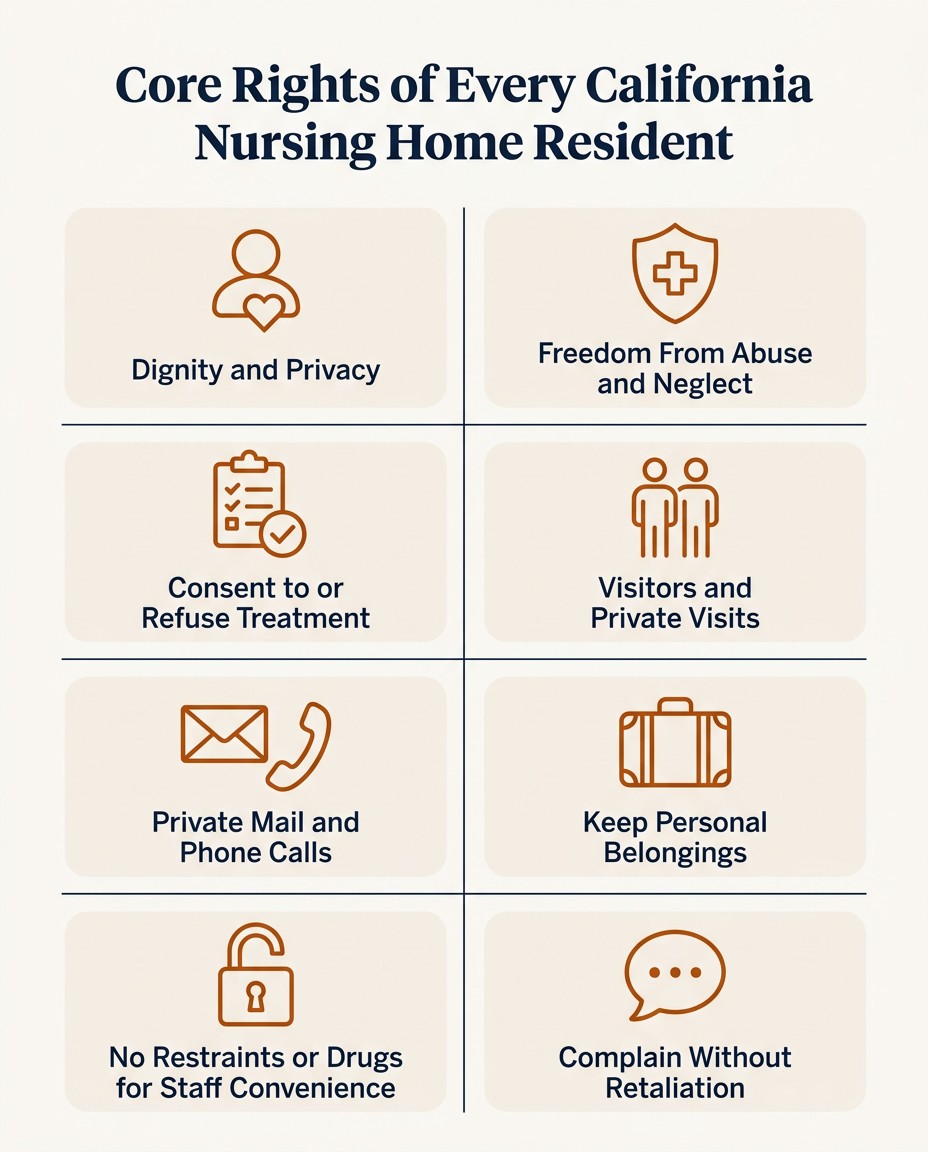
The Rights Families Ask About Most
Dignity, Respect, and Privacy
Title 22 requires that residents be treated with consideration and respect and with full recognition of their dignity, individuality, and privacy. In practice that covers things families notice right away: a resident left exposed during care, staff talking about a resident as if they were not in the room, or a call for help to the bathroom answered with "just go in your brief." Each of those moments is a rights violation, and they are often early signs of the emotional abuse and understaffing problems we see in larger cases.
Freedom From Abuse, Neglect, and Chemical Restraints
Residents have the right to be free from mental and physical abuse. They also have the right to be free from psychotherapeutic drugs and physical restraints used for discipline or staff convenience. A sedative given because a resident is "difficult" at shift change, rather than because a physician ordered it for a real medical need, is exactly what this rule prohibits. California also requires facilities to give residents the information they need to accept or refuse psychotherapeutic drugs before those drugs are started.
Basic care is part of this picture too. Section 1599.1 requires facilities to employ enough qualified staff, provide hygiene care and measures to prevent bedsores, serve adequate food, and keep a working nurse call system with the cord within the resident's reach. When those basics fail, you are often looking at neglect.
Medical Information and the Right to Say No
Residents have the right to be told about their medical condition, to take part in planning their own care, and to consent to or refuse any treatment or procedure. They are also entitled to the information they need to make that choice. If your mother has capacity and does not want a feeding tube, that is her decision. If she lacks capacity, her legal representative steps into that role. Either way, the facility does not get to decide quietly on its own.
Visitors, Phone Calls, and Mail
Federal rules give residents the right to receive visitors of their choosing, and Title 22 requires daily visiting hours, private space for visits, and clergy visits at any time on request. A critically ill resident may have visitors of their choice at any time unless it is medically contraindicated. Married residents and registered domestic partners are entitled to privacy for visits, and if both live in the facility, they may share a room. Residents also have the right to private phone calls and to send and receive mail unopened.
A facility that cuts off a family member because that person "complains too much" is on dangerous ground. Visitation belongs to the resident, not the administrator.
Money and Personal Belongings
Residents may manage their own finances. If they hand that job to the facility, the facility must provide at least a quarterly accounting. Residents may keep and use their own clothing and possessions as space allows. Missing jewelry, hearing aids that "walked away," and trust accounts that do not add up are rights issues, and sometimes financial abuse.
Transfer and Discharge
Under Title 22, a resident may be transferred or discharged only for medical reasons, for their own welfare or that of other residents, or for nonpayment, and only with reasonable advance notice. The federal rules in 42 CFR 483.15 generally require written notice 30 days ahead, with limited exceptions for emergencies, and a copy of that notice must go to the long-term care ombudsman. California gives residents the right to appeal an involuntary transfer or discharge, and the right to appeal when a facility refuses to readmit them after a hospital stay. The notice must explain how to appeal. Read it the day it arrives, because the timelines are short.
Complaining Without Retaliation
Residents and families have the right to voice grievances without restraint, coercion, discrimination, or reprisal. Families often hesitate to complain because they worry their loved one will pay the price. Retaliation is itself a violation, and it should be reported the same way as the original problem.
What Happens When a Facility Violates These Rights
This is where California goes further than most states. Health and Safety Code section 1430(b) lets a current or former resident, or their legal representative or successor, sue the facility's licensee for violating any right under Title 22 or "any other right provided for by federal or state law or regulation." The facility is responsible for its employees' conduct.
For violations on or after March 1, 2021, the statute allows damages of up to $500 for each violation, plus attorney's fees and costs, and a court can order the facility to stop the ongoing violations. That per-violation language matters. In 2020, the California Supreme Court held in Jarman v. HCR ManorCare that the old version of the statute capped recovery at $500 per lawsuit. The Legislature changed the law, and for violations since March 2021, a pattern of repeated violations can add up. Any agreement a resident signs giving up this right to sue is void.
A rights claim rarely stands alone. When a violation causes real injury, such as a bedsore, a fall, or dehydration, it usually travels with claims under California's Elder Abuse Act and ordinary negligence law. We walk through how those laws fit together in our guide to California nursing home neglect laws.

How to Use These Rights Before Something Goes Wrong
When we worked on the defense side of these cases, the families who were hardest to argue with were the ones who had used their rights all along, on paper. A few habits make a real difference:
- Keep the admission packet. The rights acknowledgment your loved one signed at admission is proof the facility knew the rules. Ask for a copy if you never received one.
- Go to care plan meetings. Residents have the right to take part in their own care planning, and their representatives can attend. Ask what the plan says about repositioning, fall prevention, nutrition, and medications.
- Put concerns in writing. An email to the director of nursing creates a dated record that a phone call does not.
- Call the ombudsman. The California Long-Term Care Ombudsman Program is a free advocate for residents. For urgent concerns, the statewide CRISISline is 1-800-231-4024, available around the clock.
- File with the state when it is serious. Our step-by-step guide explains how to file a complaint against a California nursing home, and our reporting guide covers when to call 911, the ombudsman, or Adult Protective Services.
- Learn the warning signs. Our checklist of the signs of nursing home neglect helps you describe what you are seeing in concrete terms.
You can also look up any facility's inspection history, ratings, and citations in our California nursing home directory before a problem starts.
If Your Loved One's Rights Were Ignored
A rights violation that caused harm deserves more than an apology letter from the administrator. If your family is dealing with an injury, neglect, or mistreatment in a California nursing home, call (888) 999-0169 or send us a message. When you contact us, we talk with you about what happened. The consultation is free, and you pay nothing unless we win.
Frequently asked questions
What is the California nursing home patient's bill of rights?
It is the set of protections in the Health and Safety Code beginning at section 1599, titled the Skilled Nursing and Intermediate Care Facility Patient's Bill of Rights, together with the detailed list of patient rights in Title 22, section 72527. Section 1599.1 also applies core federal resident rights rules to California facilities regardless of how the resident pays.
Can I sue a nursing home for violating my parent's rights in California?
Yes. Health and Safety Code section 1430(b) allows a current or former resident, or their legal representative or successor, to sue the facility's licensee for violating rights under state or federal law. For violations on or after March 1, 2021, damages of up to $500 per violation are available, plus attorney's fees and costs. When the violation caused an injury, other claims such as elder abuse and negligence may also apply.
Can a California nursing home restrict visitors?
Residents have the right to receive visitors of their choosing, and California requires daily visiting hours, private space for visits, and clergy visits at any time on request. Critically ill residents may have visitors at any time unless it is medically contraindicated. Restrictions should be tied to the resident's wishes or a genuine health or safety reason, not to a family member's complaints.
Can a nursing home evict a resident in California?
Only for limited reasons, such as medical need, the welfare of the resident or others, or nonpayment, and generally with 30 days' written notice under federal rules. Residents have the right to appeal an involuntary transfer or discharge, and to appeal a refusal to readmit them after a hospital stay. Contact the long-term care ombudsman right away if you receive a discharge notice.

Free Case Evaluation
Confidential. No obligation. Available 24/7.